FREE WEBINAR | November 10: Join us for an introduction to sheet metal manufacturing.
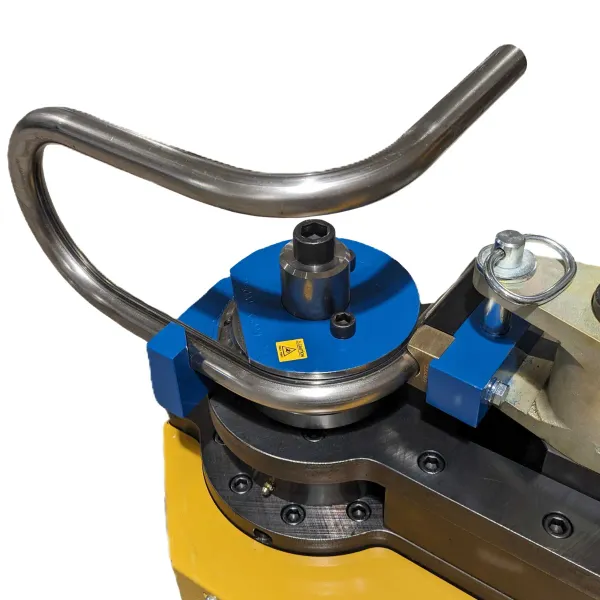
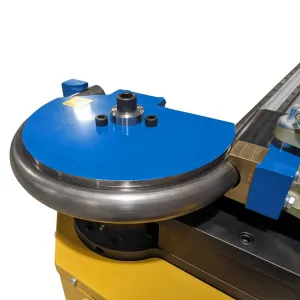
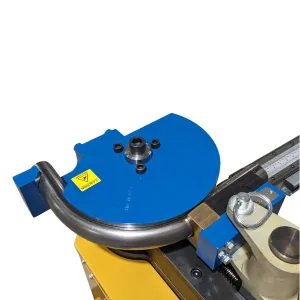
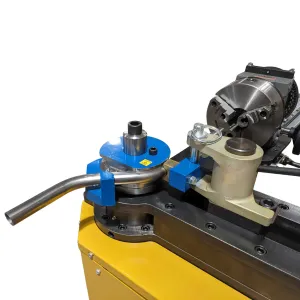
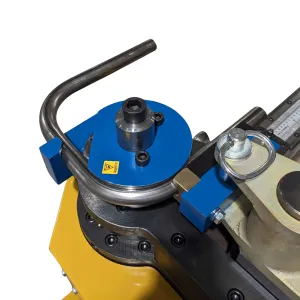
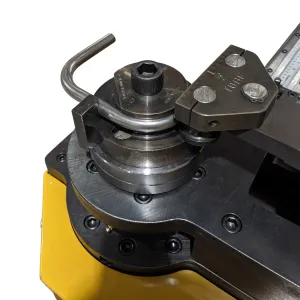
Register Now!Rotary draw bending forms tube and pipe into clean, repeatable bends of up to 180°, held to a ±1° bend angle tolerance.
The workpiece is clamped to a rotating bend die and drawn around it to the required angle, with compensation for springback.
ProtoSpace Mfg, the aerospace and defense division of Protocase, is AS9100D and ISO 9001:2015 certified and ITAR and CGP compliant.
Common applications include
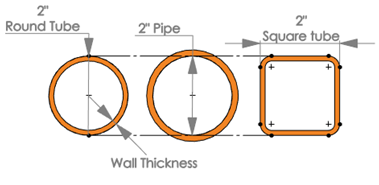
| Property | Tube Bending | Pipe Bending |
|---|---|---|
| Sizing | Defined by the outer diameter (OD) | Defined by the inside diameter (ID) |
| Wall Thickness | Measured inward from the OD | Measured outward and set by the pipe schedule (SCH) |
| Tooling | Same tube tool can bend many wall thicknesses | A pipe tool is specific to one size and schedule |
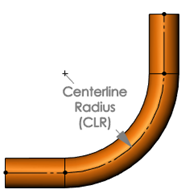
Centerline radius is the bend radius measured at the center of the tube. When a bend radius is specified for tube or pipe, it usually refers to the CLR.
Wall factor is the ratio of tube outer diameter to wall thickness:
Wall Factor = Tube Outer Diameter ÷ Tube Wall Thickness
D of bend is the ratio of centerline radius to tube outer diameter:
D of Bend = Centerline Radius ÷ Tube Outer Diameter
A DOB of 3 or greater is the ideal rule of thumb for bending without a mandrel.
Centerline Radius
Material Outer Diameter
Bend Angle
| Material | Pipe (Schedule 40) | Round Tube | Square Tube |
|---|---|---|---|
| Mild Steel | Up to 2" (50.8 mm)~60,000 psi tensile strength | Up to 2.5" (63.5 mm) ODx 0.125" (3.175 mm) wall | Up to 2" (50.8 mm) x 2" (50.8 mm)x 0.125" wall |
| Aluminum | Up to 2" (50.8 mm) | Up to 2.5" (63.5 mm) ODx 0.156" (3.962 mm) wall | Not listed |
| Stainless Steel | Up to 1.5" (38.1 mm) | Up to 2.375" (60.325 mm) ODx 0.125" (3.175 mm) wall | Not listed |
| Chromoly | Not listed | Up to 2" (50.8 mm) ODx 0.125" (3.175 mm) wall | Not listed |
A dash means that material is not listed for that stock type.
Bend centerline radius will be larger than the tool centerline radius due to material springback. Centerline radius growth of 3-5% is typical in steel tubing.
| Stock Type | Stock Dimension | Centerline Radius | Minimum Spacing |
|---|---|---|---|
| Round Tube | 0.500" | 12.7 mm | 1.50" | 38.1 mm | 2" | 50.8 mm |
| Round Tube | 0.750" | 19.05 mm | 3.00" | 76.2 mm | 3.5" | 88.9 mm |
| Round Tube | 1.000" | 25.4 mm | 3.00" | 76.2 mm | 3.5" | 88.9 mm |
| Round Tube | 1.500" | 38.1 mm | 5.00" | 127 mm | 3.5" | 88.9 mm |
| Round Tube | 1.750" | 44.45 mm | 6.00" | 152.4 mm | 3.75" | 95.25 mm |
| Square Tube | 2.000" | 50.8 mm | 7.00" | 177.8 mm | 6.5" | 165.1 mm |
Bent tube and pipe parts such as hand rails and handles, framing, wire conduit, bumpers and roll cages, exhaust systems and fluid lines.
Tube is specified by its outer diameter, so one tube tool can bend several wall thicknesses. Pipe is specified by its inside diameter and schedule, so each pipe tool fits a single size and schedule.
As a rule of thumb, aim for a D of bend of 3 or greater and a wall factor of 19 or less when bending without a mandrel.
Our standard bend angle tolerance is ±1°, with ±1° on the index angle and ±0.063" (1.6 mm) on bend position.
Yes. ProtoSpace Mfg is AS9100D and ISO 9001:2015 certified and complies with ITAR and the Controlled Goods Program (CGP).
